Download The Tyranny of Experts: Economists, Dictators, and the Forgotten Rights of the Poor, by William Easterly
The Tyranny Of Experts: Economists, Dictators, And The Forgotten Rights Of The Poor, By William Easterly Actually, book is actually a window to the globe. Even many individuals might not appreciate reviewing books; guides will constantly provide the exact information concerning truth, fiction, experience, adventure, politic, faith, as well as much more. We are here an internet site that provides compilations of publications more than guide store. Why? We give you bunches of numbers of link to get guide The Tyranny Of Experts: Economists, Dictators, And The Forgotten Rights Of The Poor, By William Easterly On is as you need this The Tyranny Of Experts: Economists, Dictators, And The Forgotten Rights Of The Poor, By William Easterly You can locate this book easily here.
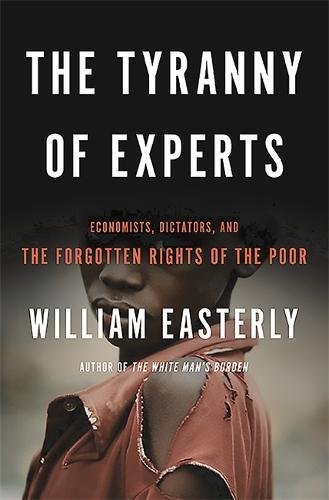
The Tyranny of Experts: Economists, Dictators, and the Forgotten Rights of the Poor, by William Easterly

Download The Tyranny of Experts: Economists, Dictators, and the Forgotten Rights of the Poor, by William Easterly
Spend your time also for just few minutes to read a book The Tyranny Of Experts: Economists, Dictators, And The Forgotten Rights Of The Poor, By William Easterly Checking out an e-book will never minimize and also lose your time to be pointless. Checking out, for some people end up being a need that is to do on a daily basis such as spending quality time for consuming. Now, exactly what regarding you? Do you want to read a book? Now, we will reveal you a brand-new publication entitled The Tyranny Of Experts: Economists, Dictators, And The Forgotten Rights Of The Poor, By William Easterly that could be a new way to explore the knowledge. When reviewing this publication, you can obtain something to constantly bear in mind in every reading time, even detailed.
If you desire actually obtain the book The Tyranny Of Experts: Economists, Dictators, And The Forgotten Rights Of The Poor, By William Easterly to refer currently, you should follow this page consistently. Why? Remember that you need the The Tyranny Of Experts: Economists, Dictators, And The Forgotten Rights Of The Poor, By William Easterly source that will provide you right expectation, do not you? By seeing this website, you have started to make new deal to constantly be updated. It is the first thing you can start to get all gain from being in a site with this The Tyranny Of Experts: Economists, Dictators, And The Forgotten Rights Of The Poor, By William Easterly and various other compilations.
From now, discovering the completed website that offers the finished publications will be several, however we are the relied on website to go to. The Tyranny Of Experts: Economists, Dictators, And The Forgotten Rights Of The Poor, By William Easterly with easy web link, easy download, as well as completed book collections become our excellent services to get. You can discover and use the benefits of selecting this The Tyranny Of Experts: Economists, Dictators, And The Forgotten Rights Of The Poor, By William Easterly as everything you do. Life is always creating and you need some new publication The Tyranny Of Experts: Economists, Dictators, And The Forgotten Rights Of The Poor, By William Easterly to be recommendation consistently.
If you still require more publications The Tyranny Of Experts: Economists, Dictators, And The Forgotten Rights Of The Poor, By William Easterly as recommendations, visiting browse the title and also style in this site is offered. You will locate even more lots publications The Tyranny Of Experts: Economists, Dictators, And The Forgotten Rights Of The Poor, By William Easterly in different self-controls. You can likewise as quickly as possible to check out guide that is already downloaded and install. Open it as well as save The Tyranny Of Experts: Economists, Dictators, And The Forgotten Rights Of The Poor, By William Easterly in your disk or gizmo. It will ease you anywhere you require guide soft data to read. This The Tyranny Of Experts: Economists, Dictators, And The Forgotten Rights Of The Poor, By William Easterly soft file to review can be recommendation for everybody to improve the skill as well as capacity.
Over the last century, global poverty has largely been viewed as a technical problem that merely requires the right “expert” solutions. Yet all too often, experts recommend solutions that fix immediate problems without addressing the systemic political factors that created them in the first place. Further, they produce an accidental collusion with “benevolent autocrats,” leaving dictators with yet more power to violate the rights of the poor.
In The Tyranny of Experts, economist William Easterly, bestselling author of The White Man's Burden, traces the history of the fight against global poverty, showing not only how these tactics have trampled the individual freedom of the world's poor, but how in doing so have suppressed a vital debate about an alternative approach to solving poverty: freedom. Presenting a wealth of cutting-edge economic research, Easterly argues that only a new model of development—one predicated on respect for the individual rights of people in developing countries, that understands that unchecked state power is the problem and not the solution —will be capable of ending global poverty once and for all.
- Sales Rank: #46653 in Books
- Brand: Easterly William
- Published on: 2015-03-24
- Released on: 2015-03-24
- Original language: English
- Number of items: 1
- Dimensions: 8.25" h x 1.13" w x 5.63" l, 1.43 pounds
- Binding: Paperback
- 416 pages
- The Tyranny of Experts Economists Dictators and the Forgotten Rights of the Poor
Review
Wall Street Journal 2014 Books of the Year
New York Times Book Review
“Bracingly iconoclastic.... Easterly's stories unfailingly reinforce a select number of crucial themes, the boldest being that the people of the so-called underdeveloped world have been systematically betrayed by the technocrats in charge of the global development agenda.”
Bloomberg View
“[Easterly] is one of the most consistently interesting and provocative thinkers on development.”
Times of London
“This powerful polemic against top-down aid projects convinces.”
Shelf Awareness for Readers
“Easterly makes essential points about human rights, the need to accommodate local factors in developing countries and the terrible mistakes that can result from deals with corrupt regimes or self-interested organizations. His argument is made with passion and ample illustration.”
Kirkus
"Easterly delivers a scathing assault on the anti-poverty programs associated with both the United Nations and its political and private sector supporters....A sharply written polemic intended to stir up debate about the aims of global anti-poverty campaigns."
Angus Deaton, Professor of Economics and International Affairs, Princeton University
“Knowledge and expertise are fountainheads of prosperity and freedom, yet experts, especially foreign experts, have frequently been instruments of the very oppression that they seek to alleviate. The Tyranny of Experts tells the extraordinary story of authoritarian development. Those not familiar with Easterly's previous books are in for a revelation, and the many long time aficionados will be delighted to be back in the hands of the master.”
Paul Romer, New York University
"Easterly's new book shows that the expert approach to development rests on an engrained but unexamined premise: that people in poor countries cannot be trusted to make their own decisions. As this wide-ranging and compelling account shows, this assumption is doubly flawed. It's morally offensive and a sure guide to bad policy."
Francis Fukuyama, Olivier Nomellini Senior Fellow at the Freeman Spogli Institute for International Studies at Stanford University
"Bill Easterly is simply the most interesting and provocative economist writing on development topics today."
Library Journal
“Easterly's research may help start a dialog about identifying better methods for alleviating global poverty and should assist readers interested in humanitarian efforts who want to draw their own conclusions about how to aid the world's poor."
Nancy Birdsall, President, Center for Global Development
“This book is deeply radical and thought-provoking, and brilliantly entertaining. Easterly invokes Kahneman, Hayek, Hirschman; the free cities of 12th century Genoa and 18th century New York; the Erie Canal, Fujian and Benin; the "prison" of the nation state; the new generation of econometrics applied to human history, and more in making his argument: It is individual rights and political freedoms that safeguard spontaneous, shared and sustained development, and the prevailing technocratic approach subverts those rights at great cost to the global poor its adherents would help. Development insiders will, with some justification, complain about one-sidedness and exaggeration. But no one who starts this book will be able to put it down, or be able to undo its influence on her thinking about the deep determinants of development progress.”
About the Author
William Easterly is a professor of economics at New York University and a senior fellow at the Center for Global Development. He was a senior research economist at the World Bank for more than sixteen years. In addition to his academic work, he has written widely in recent years for the Washington Post, Wall Street Journal, Financial Times, Forbes, and Foreign Policy, among other prominent publications. He is the author of The White Man's Burden and The Elusive Quest for Growth and has worked in many areas of the developing world, most extensively in Africa, Latin America, and Russia.
Most helpful customer reviews
33 of 34 people found the following review helpful.
Good, but perhaps not as groundbreaking as it is made out to be.
By D.K. Thompson
The Tyranny of Experts is a good read, and I recommend it to anyone interested in economic development and political change (specifically democratization). Although at times his prose comes across as overly pedagogical, Easterly's writing is entertaining as he pulls together various development histories ranging widely across time - from Northern Italy's free cities in 1154 A.D. to the British Empire in the early 20th Century to Uganda in 2010. The central argument is that the development community that has engaged the "developing world" since the end of World War II (specifically from Truman's initiation of post-war foreign aid in 1949) has focused on economic growth to the exclusion of political rights for the people in countries that are being developed. According to Easterly, development experts have made three critical mistakes: (1) development programs have treated countries/cultures as if they are "blank slates," ignoring specific historical circumstances and dynamics; (2) policies and measurement of "development" have focused on the national level, whereas development may be at the same time more localized (progress taking place within specific communities) as well as more regional (the broader economic/environmental/social setting of development clearly has a strong regional component) than this analysis acknowledges; and (3) development experts have chosen to consciously design solutions to problems, whereas historically a free market has been the best problem-solver.
To make his point, Easterly examines a broad range of statistics, anecdotes, documents and quotes from development experts and organizations. Criticizing the supposedly apolitical approach of organizations like the World Bank, he shows how development institutions have undermined individual rights. In this he is certainly not alone - much of the book reminded me of a kind of cross between Michael Goldman's "Imperial Nature" and any of Paul Farmer's books about individual rights and development (perhaps "Pathologies of Power" would be a decent comparison). A significant contribution Easterly makes to this body of development literature is that he includes a brief and selective analysis of how cultural values, individual rights, and economic growth go hand in hand. Drawing on academic studies, he shows how democracy and cultural freedom work in a virtuous feedback loop; where oppression has taken place, social trust tends to be very low, which hinders the development of democracy and individual rights. This is a significant insight, although clearly made previously by the studies that Easterly cites.
Surprisingly, while Easterly examines the British Empire and American international engagement from the standpoint of political rights, tracing the strand of imperial-minded racism that tainted the origins of the development community, he attributes economic growth in Britain and America almost solely to political freedom (more by declining to mention empire and territorial expansion outside of the political context than by making this argument explicitly). Yes, there is a statistical link, as he recognizes, between the existence of checks on authoritarian power in Western European countries at the beginning of Atlantic trade and their benefit from that trade (p. 137-139). Furthermore, individual incentives play an important role in invention and technological development as well as trade and weathering economic shifts. Yet I feel that this book comes up short by being somewhat selective in the histories that it tells as well as glossing over the exploitation permitted (some would say created) by markets. We can agree that individual rights are essential and valuable as ends in themselves. While criticizing the development community for overlooking history, Easterly holds up the countries with individual rights for their citizens as examples for other societies/political entities to follow yet gives short shrift to the history of economic development in these countries themselves. America grew to its current status as a world economic leader because of individual rights, but also because of the expropriation of land in North America, the development (alongside individual rights) of an expansionist attitude in culture, and financial power that extracts value from beyond its own borders. Individual rights in Britain at the beginning of Atlantic trade may have helped the island nation gain technological advantages and dominate sea trade, but raw materials from the empire and the exploitation of workers in Manchester factories also played a large role in getting Britain to where it is today. Easterly's selectivity suggests that there is a lot of work to be done in bringing a broader history of development to light.
To a large extent, development has become a business that is about sustaining itself, whereas it should be about ultimately eliminating the need for a development community. In advancing this viewpoint, Easterly is doing a service to many. Having worked in both local and international development organizations, I will say that despite my reservations, Easterly achieves his goal of contributing to the development debate in a way that opens the floor for future conversation and research.
The bottom line: While it may not be completely groundbreaking, I do think Easterly's latest book does a good job synthesizing information on the recent history of development and pulling together various strands of theory (economic, political, and cultural) into the development debate. It is a worthwhile read.
70 of 75 people found the following review helpful.
Bill Gates, please read this book!
By Hal Jordan
William Easterly, an economics professor at NYU, has written several iconoclastic books on economic development. His latest book is his best, in my view. The book provides a history of development policy from the early twentieth century onward. Easterly analyzes how what he labels "authoritarian development policy" -- state-run, top-down policy -- came to dominate the field of development so thoroughly.
Easterly sees the consequences of this dominance as being tragic, with governments and their hired experts having run roughshod over the interests of poor people. His book provides many examples of callous remarks by development officials dismissing the hardships their policies have imposed on people whose lives were plenty hard enough to begin with. Easterly is skeptical of the technocratic, data-driven policies that Bill Gates has been associated with in recent years, doubting the reliability of both the data these policies are based on and the rosy assessments of the outcomes of the policies.
Easterly worked for years at the World Bank and had a ringside seat at the formulation and implementation of the Bank's polices, most of which he now sees as ineffective and, often, counterproductive. He certainly has the credentials to make these arguments; it will be interesting to see what counterarguments the development policy establishment makes. I would hate to think that Easterly's arguments will be ignored, but he notes that similar arguments in the past have been.
Much as I like the book, I do have a few caveats. I like the fact that the book is fairly brief and very readable -- I probably wouldn't have read it if it hadn't been! -- but the scholarship seemed a trifle thin to me. Particularly the first few chapters, which deal with the origins of development policy as found in British policy during the later stage of the empire, policy in Nationalist China, and U.S. policy in Latin America, seem to rely heavily on a few secondary sources. Even then, I'm not sure how thoroughly he has read some of these sources. For instance, in discussing Harry Dexter White's views at the Bretton Woods conference, he relies on Steil's recent book on Bretton Woods. But Steil makes rather a big deal of White's having turned out to be a Soviet agent, a fact that Easterly doesn't mention, although it would appear to provide additional insight into why White supported authoritarian policies.
Easterly also indulges in a little too much "roadmapping" of the "as we saw in the last chapter" and "having discussed x, we will now discuss y" and "once we finish discussing y, we will discuss z in the following two chapters." Kind of reminded me of an undergraduate term paper.
These are quibbles, though. Easterly has written an important book. One that I hope Bill Gates and the rest of the development policy establishment feel obliged to come to grips with.
2 of 2 people found the following review helpful.
A Thrashing Of Bill Gates And The Legacy Development Industry
By Charles
William Easterly is a leading critic of traditional approaches to development—that is, of traditional approaches to bridging the Great Divergence. He, and everyone else studying development, want to know why and how the West and a few Western-influenced countries have become wealthy, and everyone else in the world has stayed poor, despite trillions of dollars spent fruitlessly over seven decades by the West to bring the poor out of poverty.
Easterly’s latest book focuses on the defects of autocratic technocratic development schemes cooked up by Westerners. Such schemes treat citizens of undeveloped countries as fungible pawns to be passively developed, and result in no positive outcome. Easterly suggests that superior outcomes are likely from instead empowering individuals in developing countries to make their own choices. Easterly’s core premise, the one around which everything in this book revolves, is that releasing the talents, ingenuity, hard-work and self-motivation of poor people from the bondage of central planning and repression of individual rights will allow those people to lead themselves out of poverty. He is a modern-day Moses, saying to the Pharaoh of the global development industry, “Let my people go!”
A prime service of this book is the historical perspective Easterly gives the reader. He discusses at length the origins and growth of the development industry (i.e., the complex of national and multi-national organizations that receive money from individuals and governments, and undertake to apply that money to the development of undeveloped countries). The reason the historical perspective is valuable is that the development industry thrives on ignoring the past. In the development industry, the focus is relentlessly on the future—on today’s Utopian plans that, with enough money from others, are promised to finally bring about the elevation of the poor, despite all the failures of the past seven decades. A current example of this focus is the UN Millennium Development Goals, pushed globally by a wide range of players in the development industry, perhaps most prominently by the Gates Foundation. The reason for the focus on the future, of course, is that a focus on the past would show what a gruesome failure the development industry has been for seventy years, and might even require accountability for all the trillions wasted and Utopian promises totally unfulfilled.
Easterly frames the book around what development should NOT be and do. To do this, he discusses at length the once-lionized, now-forgotten Nobel laureate Gunnar Myrdal. He posits a fictional debate between Myrdal and the not-forgotten Friedrich Hayek. Through that device, he analyzes Myrdal’s thought, showing three major pillars that underlie the development industry today. First, Myrdal held that every society is a blank slate, just waiting for a cookie-cutter solution to be imposed by outsiders, rather than a unique culture with its own unique needs and desires. Second, the focus in development should be on abstract national well-being rather than on the well-being of individuals. Third, technocratic government central planning rather than spontaneous individual action leads to development success. (Interestingly Myrdal’s highly successful response to his own critics at the time was to refuse to debate them and instead shriek that there was a “consensus” in favor of his views, so everyone who disagreed was stupid, not part of the development priesthood, and should just shut up—shades of today’s climate change alarmists.)
The rest of the book uses this three-part framework to analyze the modern development industry, with the conclusion that Myrdal was wrong on all counts and that his thought was in many ways the original sin that has caused the development industry to be a nearly total failure. Easterly’s writing is anecdote heavy. He writes in a jaunty style, as well—presumably his main goal is to keep the reader’s interest, while fitting anecdotes into his framework. This approach is pretty successful. Each of these pillars of the modern development industry (the blank slate; national well-being over individuals; and central planning over spontaneous activity) gets a thorough beating, though Easterly is careful to note that he does not promise an alternate utopia, merely a revised way of doing things that on average is likely to be more beneficial for people of the undeveloped world. Easterly also addresses possible counter-arguments, most importantly by pointing out that the few non-Western countries that have successfully developed, namely a set of Asian nations, are almost certainly not the result of some unique type of successful Asian autocracy, but rather the result of simple economic freedoms combined with technology.
One flaw of the book is that Easterly never considers whether it’s not just the technocratic central-planning and one-size-fits-solutions that are to blame, but also the people of undeveloped countries themselves. He does not consider if some cultures are simply not as good at, or totally incapable of, lifting themselves up by their own bootstraps. There is non-trivial evidence this is the case, and a cottage industry of writers to this effect. For example, the very existence of the Great Divergence suggests this conclusion, in that the tools that enabled the Industrial Revolution, where productivity soared om England and areas with an English-style culture, have not been adopted by much of the world in the past 150 years, even though there is no obvious barrier to doing so. Gregory Clark’s “A Farewell To Alms” discusses this extensively.
No doubt Easterly perceives a focus on cultural differences as pessimistic, and he is nothing if not an optimist. Easterly does recognize some cultural differences, in particular noting that some societies recognize individual rights, instead of collective rights, and that different levels of trust characterize different societies. He correlates lack of individual rights and lack of trust with lack of development—though as usual, he is cautious in drawing sweeping conclusions. But he does not consider more baleful and harder-to-address cultural characteristics such as high time-preference (i.e., laziness), certain religions inculcating fatalism and apathy, opposition to hard work (especially manual work for men, such as in Arab cultures), predilections for violence, inability to plan for the future, and lack of impulse control. All these characteristics are common in cultures outside the West and the Far East (and yes, I mean to use “Far East,” or alternatively “The Orient”). Such cultural obstacles seem nearly insurmountable, regardless of rights or other empowerment given to individuals, and it may well be the failure of the development industry is not due just to the wrong approach, but to the impossibility of the task. Perhaps where the culture needs outside help, it cannot use it; and where it can use it, it does not need it (which is pretty much the point of Angus Deaton’s “The Great Escape.”)
On a more specific point, reviewers strangely repeatedly criticize Easterly for his fascinating multi-century historical analysis of New York’s Greene Street. They frequently say it’s irrelevant and pointless. Nothing could be farther from the truth. It’s obvious to any open-minded reader that Easterly’s point (which he makes explicit, so it’s not hard to miss) is that the history of Greene Street shows how individual rights, such as those found only in America and a few other countries, lead to spontaneous individual decisions. And that those individual decisions, with individuals directly making choices and individuals organizing together in a democratic framework, maximize societal benefits—and, just as importantly, that government planning and blank-slate impositions, even if well-meaning, are likely to lead to much worse results. It is a microcosm of Easterly’s point about nations. Easterly’s history of Greene Street culminates in Robert Moses’s mid-century plan to demolish the entire area and turn it into a centrally-planned paradise (which, like all such paradises, would shortly have become a hell, just like the liberal-led technocratic destruction of urban ghettoes and replacement by high-rise public housing was a total disaster, now falsely blamed on supposed conservative racism). But Moses was stopped by Jane Jacobs, and Greene Street is now a wealthy, redeveloped area, purely as a result of individual actions and choices. Easterly means we should expand this microcosm to the globe. It’s certainly better than what we’ve been doing—as they say, the definition of insanity is continuing to do what has failed and expecting a different result. Bill Gates should pay attention.
The Tyranny of Experts: Economists, Dictators, and the Forgotten Rights of the Poor, by William Easterly PDF
The Tyranny of Experts: Economists, Dictators, and the Forgotten Rights of the Poor, by William Easterly EPub
The Tyranny of Experts: Economists, Dictators, and the Forgotten Rights of the Poor, by William Easterly Doc
The Tyranny of Experts: Economists, Dictators, and the Forgotten Rights of the Poor, by William Easterly iBooks
The Tyranny of Experts: Economists, Dictators, and the Forgotten Rights of the Poor, by William Easterly rtf
The Tyranny of Experts: Economists, Dictators, and the Forgotten Rights of the Poor, by William Easterly Mobipocket
The Tyranny of Experts: Economists, Dictators, and the Forgotten Rights of the Poor, by William Easterly Kindle

Tidak ada komentar:
Posting Komentar